
few days ago we received an email from the Argentine Research Mario Benedetti Benedetti Professor we will have a estimated special.
Benedetti along with many other Latin American and English researchers bring their important work at CERN in Geneva and we do and will in the future everything in our power to publish their work.
is why we then gave a lecture about CERN and the LHC Professor Mario Benedetti.
private reply to your email but from here we encourage them to continue with their research and to continue lecturing and indeed many English Universities would surely be delighted to welcome and that their powers of science to lecture, what guidelines to encourage administrate. We acknowledge
weakness for the Faculty of Sciences of the Universidad Autonoma de Madrid UAM, know more than a student of physics who would be happy to attend.
Video-conference to the general public about the features and applications of the Large Hadron Collider (LHC), CERN in Geneva, Switzerland. The talk is in charge of Argentine researcher Mario Benedetti. For comments, suggestions, corrections or conference can be reached at mail @ cern.ch mario.benedetti
For those who do not know
http://www.argentina.ar/ published on March 30 2010, this article about the collaboration at CERNArgentina
Members of the Electronics Department, Faculty of Engineering, National University of Mar del Plata created a power for the particle accelerator, which will make discoveries in physics. Mar del Plata
continues to collaborate in the development of the Large Hadron Collider (LHC as the acronym), better known as Machine God. The members of the Laboratory of Instrumentation and Control (LIC) within the Department of Electronic Engineering Faculty of the Universidad Nacional de Mar del Plata, created a new source of supply for this particle accelerator that will make new discoveries in physics.
These days, engineers and fellow Mario Benedetti Nicolas Wassinger, are coming together in Geneva at the European Center for Nuclear Research (CERN), which is one of the most important machines developed in recent years and the most impressive of its kind and where there was a very important test related to the topic.
Within the Large Hadron Collider (LHC) at CERN's Atlas detector, which measures 46 meters long, 25 meters high and 25 meters wide. The detector weighs 700 tons and consists of 100 million sensors that measure particles produced after proton proton collisions at the LHC.
patience to see the animations have to download the browser and it takes a while ...
http://teknociencia.es/videos/atlas/Episode1.swf http://teknociencia.es/videos/atlas/Episode2.swf
LHC Animation teknociencia.es
"Once the particles pass through the magnetic field created by superconducting magnets, the sensitivity of the detector will help determine the trajectories of particles with an accuracy of a hair, "said Benedetti. He added that "we have a new vision of elementary particles that make up our universe," he said after considering the experiment as a "giant microscope." Through this machine hope To understand the symmetry between the amount of matter and antimatter in the early universe. "In fact we know that the universe exists a very large amount of matter that do not know, and there is a chance that can be found here," said the engineer. While no one is sure what there is to be found, scientists have suspected and hoped to be able to define the Higgs particle (called the God particle), which they believe is responsible for the mass of all particles.
In this context, and following an agreement signed last year between the Laboratory and CERN, from Mar del Plata, the researchers had on this occasion the challenge of creating a new power, surpassing the previous years had already made for this machine.
"By the year 2013 in the CERN are planning to increase the luminosity of the accelerator, which means practically increase the amount of particles that are in the packages, so we developed a new source for LINAC4 (linear accelerator startup ), "Benedetti said hours before departing for Switzerland, where he will meet with the fellow Wassinger and make final tests with the CERN people, and so ready to leave this new invention.
"Last year we proposed a topology and validated in Switzerland in 2009. Then he continued to work in Argentina along with the fellow Rogelio García Retegui and tuning was achieved. In parallel, developed two prototypes of a low level of this source, which were approved by CERN, "said Benedetti, who added:" After two prototypes made at trial that were made to operate in Mar del Plata and Geneva and now they decided to build scale. "
On April 8, expect to receive final approval of this development and get a new challenge that will keep the contact between the two entities.
History Laboratory Instrumentation Laboratory Control and began operations in December 1983, from arrival at the National University of Mar del Plata engineer Mario Benedetti, who with the support of the then director of the Department of Electronics, engineer Evan Ciner, established this working group. Its foundation was the initial act of a series of creations that gave rise to four research labs in electronics.
In recent years, this laboratory investigated in the field of power electronics, an area of \u200b\u200belectronic origin, but intended to nearby industrial and electrical installations. This laboratory was recently recognized in various fields for their participation in the development of LHC (Large Hadron Collider), better known as "The God Machine.''
currently has ten researchers and five fellows are: Mario Benedetti, Dr. Daniel Carrica, engineer Gustave Uicich, J. Krzemien engineer, engineer W . Kloster, Dr. P. Donato, Dr. S. Gonzalez, Dr. M. Funes, R. García Retegui engineer, engineer S. Maestri. And the fellows are: N. Carugati engineer, Mr. N. Wassinger, Mr. J. Fischer , Mr. M. Herran, Matthias Hadad, and Paul Antosczczuk.
An award last year, Benedetti received the top award from the Academy of Engineering of the Province of Buenos Aires. This is the consecration Award "Engineer Ortale Achilles," which was also a recognition of the work of a group representing the city in the world.
http://www.argentina.ar/
I also commented the following:
CienciaPorTV channel where videos will be posted on physics. Remember
subscribe on YouTube
http://www.youtube.com/user/CienciaPorTV
And how could it be otherwise in and http://www.teknociencia.com/ http://www.abiertohastaelamanecer.ws have created in our channel youtube an automatic playlist of videos and lectures CienciaPorTV channel which will be adding the videos posted to 50 being the maximum.
The url of the list is as follows:
http://www.youtube.com/view_play_list?p=195DBBC788C96006
Higgs boson on the brief
The Higgs boson is a hypothetical elementary particle mass whose existence is predicted by the standard model of particle physics. It is the only Standard Model particle that has not been observed so far, but it plays an important role in explaining the origin of the mass of other particles elementary, in particular the difference between the photon (massless) and W and Z bosons (relatively heavy). Elementary particle mass and the difference between the electromagnetic interaction (caused by photons) and the weak force (caused by the W and Z bosons) are critical to many aspects of the microscopic structure (and hence macroscopic) matter. With this, if the particle exists, the Higgs boson would have a tremendous impact on physics and the world today.To date, no experiment has directly detected the existence of the Higgs boson. The Higgs mechanism, which gives mass to vector bosons, was theorized in 1964 by Peter Higgs, François Englert and Robert Brout (who worked on the ideas of Philip Anderson), and independently by GS Guralnik, CR Hagen and TWB Kibble. Higgs, in a commentary attached to a letter to the Physical Review, proposed that the existence of a massive scalar particle could be a test of the theory. Steven Weinberg and Abdus Salam were the first to apply the Higgs mechanism of spontaneous symmetry breaking. The electroweak theory predicts a neutral particle whose mass is not too far from that of the W and Z bosons
particle called the Higgs boson is a quantum of one component of the Higgs field. In a vacuum, the Higgs field acquires a vacuum expectation value (VEV) different from zero that remains constant over time and everywhere in the universe. The VEV of a Higgs field is constant and equal to 246 GeV. The existence of a nonzero VEV is of fundamental importance: it gives mass to every elementary particle, including the Higgs boson itself. In particular, the spontaneous acquisition of a nonzero VEV breaks gaugiana electroweak symmetry, a phenomenon known as the Higgs mechanism. This is a simple mechanism to give mass to a gauge boson which is also compatible with the gauge field theory.
In the standard model Higgs field consists of two neutral and two charged fields. The two charged components and one neutral are Goldstone bosons, which have no mass and become, respectively, in the longitudinal components of third-polarization of the W and Z bosons (mass). The quantum of the remaining components correspond to neutral massive Higgs bosons. Higgs field is a scalar field, the Higgs boson has a spin zero and has no intrinsic angular momentum. The Higgs boson is also its own antiparticle and has CPT symmetry.
The standard model does not predict the value of the Higgs boson mass. If the Higgs mass is between 115 and 180 GeV, then the standard model may be valid to all energy scales up Planck scale (1016 TeV). Many theories are on the lookout for new physics beyond the Standard Model might emerge at scales of TeV, based on the shortcomings of the standard model. The highest possible level permitted in mass Higgs boson (or some spontaneous symmetry breaking) is of a TeV, after that point the Standard Model becomes inconsistent without such a mechanism because the uniqueness is violated in certain scattering processes. Many models of supersymmetry predict that the Higgs boson has a mass only slightly above current experimental limits, about 120 GeV or less.
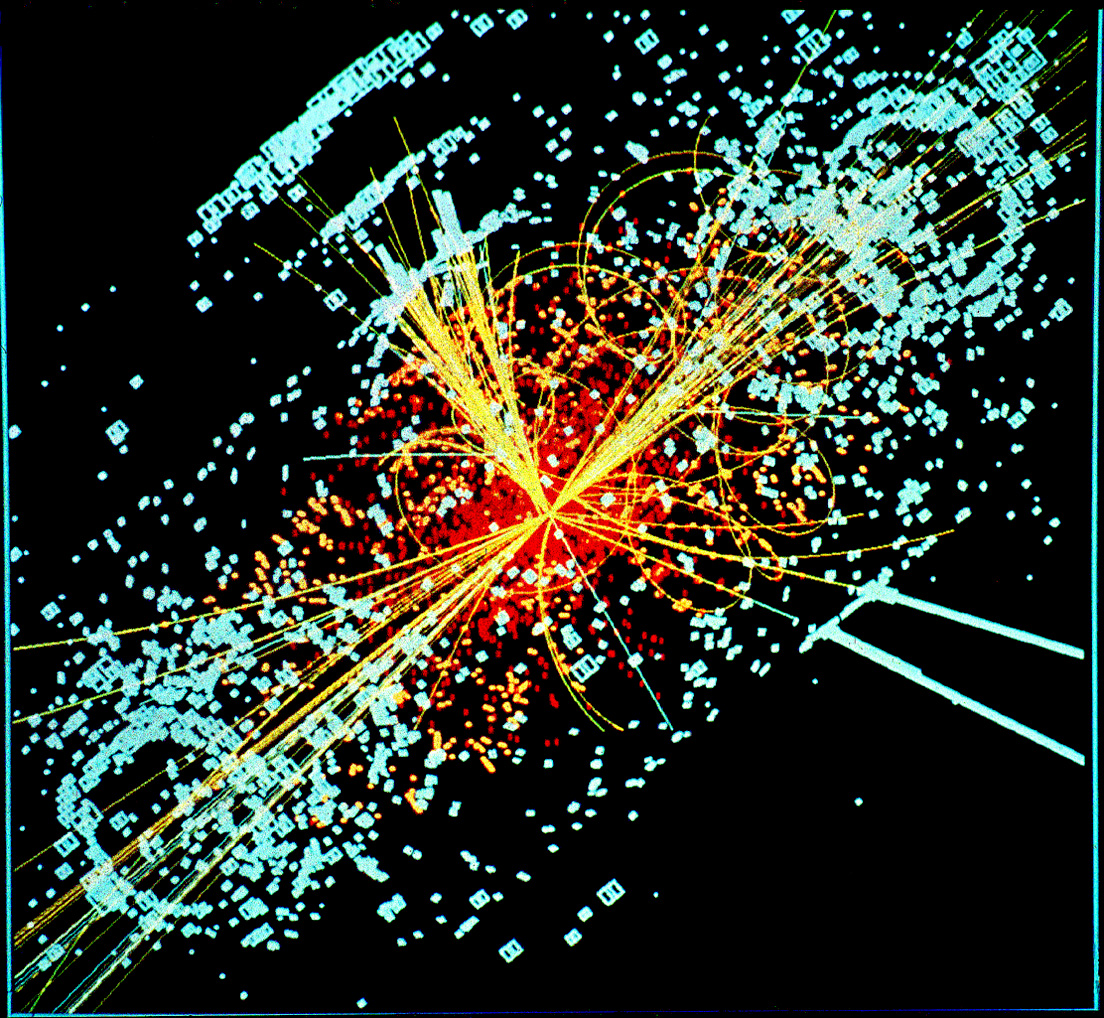
The Higgs boson search is also the aim of some experiments at the Fermilab Tevatron and the LHC at CERN.
Bibiography Wikipedia.org
Download PDF
http://teknociencia.es/videos/atlas/z-boson-ee.swf
http://teknociencia. com / videos / atlas / Detects-particles.swf
http://teknociencia.es/videos/atlas/muon-spectrometer.swf
http://teknociencia.es/videos/atlas/inner- detector.swf
http://teknociencia.es/videos/atlas/hadronic-calorimeter.swf
Original Concepts Physics: From matter and energy.


0 comments:
Post a Comment